Hermès just opened the first outpost of Shang-Xia, a new luxury lifestyle brand based in PRC for PRC consumers. The brand reflects Hermès' legacy of artfulness and fine craftsmanship. Products like cashmere sweaters and fine porcelain showcase Chinese craft traditions with a contemporary minimalist twist. The small store opened in Shanghai at the Hong Kong Plaza Mall, additional stores are planned for Paris and Beijing in due course.
The establishment of Shang-Xia is evidence Hermès has found its footing in China and has the confidence to experiment. It may also confirm that the PRC consumer is growing more sophisticated. David Tang's Shanghai Tang has an early lead as the original homegrown luxury brand. PRC Consumers are experimenting beyond European and American brands – and are prepared to embrace a distinctly Chinese take on luxury lifestyle.
Shang Xia is the second Asian brand to be launched by a western company. Last month Levi Strauss & Co established Denizen, a denim brand aimed at the PRC mass market.
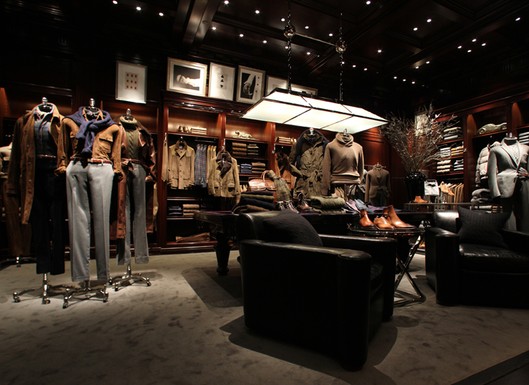
Last week in New York, I stopped by to check out the newly restored Rhinelander, which just reopened as the Ralph Lauren menswear store on Madison and 72nd. Even though it's still hidden behind scaffolding and construction scrim, the store opened for business at the start of Fashion Week. The newly constructed women's & home flagship is set to open across the street in a few weeks.
The space recalls a posh men's club... all polished mahogany, deep leather seating and richly colored hues. It goes without saying that the store is beautifully designed and the service was excellent. However, the RL merchandising team could use a lesson in restraint – in this case, less would be more. As I navigated Purple Label, I nearly knocked over a bespoke mannequin and his friend. I also had trouble finding the timepieces, which I was astounded to learn flank the front door – in plain view, but overshadowed by other gorgeousness. The sky-lit fourth floor RLX boutique was a much needed respite from the navigating dark rooms alongside Russian oligarchs.
Two weeks ago, American Express Publishing and marketing consultants at the Harrison Group released the 2010 Survey of Affluence and Wealth in America. The report details changes in the spending habits of wealthy consumers since the beginning of the Great Recession. This latest survey is an excellent indicator of long-term effects of the contraction, since consumers have emerged from their foxholes and are spending again.
One important trend documented is the emergence of wealthy "Precision Consumers." Whereas four-five years ago, these folks loosened their wallets in every category – from apparel to electronics to autos, spending liberally on everything. The Precision Consumer is still interested in luxury products but is better researched and more careful to purchase. They spend liberally in select categories where they feel luxury delivers value and fulfills explicit needs and wants.
This week, a MasterCard Advisors Spending Pulse report showed further evidence of the rise of the Precision Consumer. Spending in the electronics category is growing while apparel spending growth is stagnant. Of course, if you saw the lines outside of Apple stores last month, you didn't need to read a bunch of spending surveys to come to the same conclusion.
As retailers fight to get customers back into stores, prognosticators have hoped the high-end of the market would be the first resume spending. Even though luxury's core wealthy customers have not been as hard hit as aspirationals, there is more evidence that the return to old spending habits is a long way off. The highest end of the market continues to cut back spending in all categories. Maybe the rich really are like the rest of us.
Why is this? Well, wealth (like everything) is relative. Even though it's hard to muster sympathy, in high end real estate markets, the lower end is suffering. Foreclosures and short-sale blues are hitting these consumers just as in middle class markets – one in seven mortgages over $1 Million is seriously delinquent. Last week, the New York Times wrote about the spike in payment delinquencies and short-sales in Los Altos, CA, where the median home price is $1.5 million. Note to Los Altos: Palo Alto is snickering at you.
I spoke with one customer who related her story of shopping at Ralph Lauren in Atlanta. She fell in love with an evening gown at the store, but wasn't ready to bite at the $6,000 price point. As soon as the dress was marked down to $2,000, the sales associate called her personally and she was ready to buy. Just like us? Relatively.
For a luxury brand to develop its customer base, it must build awareness. But sometimes, high consumer awareness undermines goals - a brand can upset or drive away core or likely customers.
I find this 2X2 helpful for understanding why a brand appeals to certain consumers, which is a good place to start devising marketing and partnership strategy. I divided awareness on two axes: the vertical axis represents mass-consumer awareness and the horizontal is awareness among likely and current luxury customers.
In the upper right-hand quadrant, you’ll find brands that are instantly recognizable. These brands make big statements. It’s no wonder that the brands playing in this space appeal especially to consumers who are be a wee-bit ostentatious... They like driving a Mercedes that everyone knows is luxury.
Quadrant 2 contains luxury brands for whom mass awareness is unappealing – but its still very important that luxury consumers understand and identify the brand. Bottega Veneta derives much of its brand strength by creating the perception of discreteness. A signature weave, never a logo, makes a subtle but clear statement to peers.
Some brands thrive in relative obscurity... lower left-hand quadrant contains brands that are regional or for luxury connoisseurs. These customers derive a great deal of satisfaction from being in on a brand-secret and might be upset if it becomes too well-known… even by peers. John Lobb would have a hard time making customers covet $4,000 shoes without this sort of proposition.
Why would a luxury brand ever want to have low awareness by likely customers and high awareness among a mass audience? Even if it did make sense, I’m not sure it’s possible.
For a luxury brand to develop its customer base, it must build awareness. But sometimes, high consumer awareness undermines goals - a brand can upset or drive away core or likely customers.
I find this 2X2 helpful for understanding why a brand appeals to certain consumers. It’s a good place to start devising marketing and partnership strategy. I divided awareness on two axes: the vertical axis represents mass-consumer awareness and the horizontal is awareness among likely luxury customers.
In the upper right-hand quadrant, you’ll find brands that are instantly recognizable. These brands make big statements. It’s no wonder that the brands playing in this space appeal especially to consumers who are be a wee-bit ostentatious... They like driving a Mercedes that everyone knows is luxury.
Quadrant 2 contains luxury brands for whom mass awareness is unappealing – but its still very important that luxury consumers understand and identify the brand. Bottega Veneta derives much of its brand strength by creating the perception of discreteness. A signature weave, never a logo, makes a subtle but clear statement to peers.
The third and lower left-hand quadrant contains brands that are regional or for luxury connoisseurs. These customers derive a great deal of satisfaction from being in on a brand-secret and might be upset if it becomes too well-known… even by peers. John Lobb would have a hard time making customers covet $4,000 shoes without this sort of proposition.
Why would a luxury brand ever want to have low awareness by likely customers and high awareness among a mass audience? Even if it did make sense, I’m not sure it’s even possible.
Perhaps no brand's icon is as quickly and uniformly associated with "The Good Life" as the embroidered rider on his polo pony. It means wealth, leisure and Pimm's cup on the terrace in the afternoon. The story is instantly familiar: a Baruch college dropout working as a sales associate at Brooks Brothers started selling ties of his own design to downtown investment bankers. In several years he builds a multi-billion dollar fashion and retail empire. He was born Ralph Lifshitz, son of a house painter from the Bronx. You know him as Ralph Lauren.
The genius of Ralph Lauren isn't his merchandise, it's his merchandising. He has permanently changed the way we shop by building environments that sell a complete lifestyle. His creation of the Polo Mansion (aka: the Rhinelander Mansion) in 1984 on Madison and 72nd is the most influential retail concept in the last 40 years. Here, you step into the home of some impossibly wealthy robber baron, wander the halls and acquire good taste. The formula is oft copied and Polo Ralph Lauren went on to create "mini mansions" in fashionable downtowns and tony malls throughout the world.
Today, Polo threw open the doors of its first mansion-store at 173 Boulevard Saint Germain in Paris. Yes, there is a women's store on Avenue Montaigne and his first Parisian outpost on Place de la Madeleine, but never before today has there been a Polo store in Paris which rivaled the Rhinelander. Abby and I rode our Velibs across the Seine to pay a visit this afternoon. Judging from the perfectly coiffed heads milling about us, we were joined by every doyenne in Paris for opening day. The store is laid out on five glitteringly appointed floors of palatial proportions. This isn't Hemingway's post-war Paris… this 17th century mansion is straight out of Edith Wharton.
Upstairs, a perfectly tailored salesman in a tweed jacket helped me discern the difference between two single breasted navy blazers (boring, I know – but a void in my wardrobe.) Following the Colette incident, I've been longing for black boots and thought I struck upon a compromise: a sleek pair of black chukkas that would work well with a suit or jeans (day-into-evening!) I asked a tall, handsome, square-jawed salesman if I could try them on in my size and pondered if I should also ask for his number. "These, sir, are made-to-measure." Out of my league… on both counts.
Abby and I were secretly hoping of running into Ralph, and dressed accordingly. Regrettably, he was not in the store today. As I stood outside taking a photo of the facade, a well-tailored gentleman with a British accent cracked a joke that my photo was the only thing I'd get free from the store. Turns out I was speaking to Julian Griffiths, Senior Director of Operations for Polo Ralph Lauren in Europe – Griffiths was responsible for developing the new store. He explained that today was the culmination of a four-year labor of love - with heavy emphasis on labor. The mansion, once a grand address, had fallen into disrepair and was used for decades as a less-than-grand office building. The architects and designers had to clear away makeshift walls, rebuild the main stairwell, and completely redesign and replant the central courtyard.
The end product surpasses the Rhinelander store – the light is superior, the flow more conducive to browsing, the setting more splendid and something quite – je ne sais quoi – Parisian?
Located within easy walking distance of several of Paris' most storied hotels: the Crillion, Bristol, Hotel Costes and the Ritz, Rue Saint Honore is the city's traditional luxury retail center. While it's been replaced in importance by the Avenue Montaigne and Avenue des Champs Elysees, which offer brands larger and brighter quarters, Saint Honore (aka: the Faubourg) still draws droves of black card wielding shoppers. The neighborhood, sandwiched between Jardin Tuileries and Place Vendôme, has given rise to the Parisian stereotype of the grande dame, dressed in a Chanel knit suit, taking her toy-sized dog for a stroll.
Colette, located on the corner of Sainte Honore and Rue du 29 Juillet, lies at the very heart of the Faubourg. In contrast to its neighbors, this store does not take itself too seriously. Colette, quite simply, is the Capitol of Cool in the world's fashion capitol. New York has Jeffrey, LA has American Rag and Fred Segal, but none of these approaches Colette in terms of identifying and pushing trends forward so often and successfully. The merchandising brings high fashion down to earth, with mannequins dotted around the sales floor like sculptures in a garden, allowing patrons a very close look at the details of garments. Never installed long enough to gather dust, the brilliant windows showcase new merchandise and inspire fresh desire in customers each week.
What I love most about the store is the variety of categories and price points on display. On the first floor are well selected, affordable goods for the home, including books, accessories and electronics, as well as sportswear, timepieces, denim, and a floor-to-ceiling lucite wall of sneakers. Upstairs, beyond the collage of (ahem) coital photography, are designer runway looks. You probably won't find any Prada or YSL here, this is the territory of what is and who is "next." Alexander Wang, Viktor & Rolf and Raf Simmons are featured as prominently as more established labels. I found a great summer-weight cotton blazer by Michael Bastian and a pair of black dress boots – sadly (or divinely,) my student-abroad budget does not afford a 1,700€ jacket and the boots were not available in my size.
The Water Bar, located on the basement level, conducts the most naked sort of thievery of any cafe in Paris. The restaurant serves 57 different kinds of calorie-free Eaux to an assortment of painfully self-conscious, whippet-thin fashion types. If you want your water to leave you with a hangover, try a bottle of the "Bling," which hails from the mountains of Tennessee, is served in a Swarovski crystal bottle and will set you back 50€.
Few things can focus one's mind on mortality like airplane turbulence. Bouncing around 35,000 feet over the Pacific Ocean, one can't help but think of plunging into the frigid Bering Sea. And so, I blog to distract.
After a visit to East Asia, it's hard not to ponder the impact the fakes market has on designer goods and brands. As I boarded this flight from Shanghai to Chicago, a parade of roller-duffels emblazoned with grand initials (lots of LV's, interlocking G's, bold C's) were stuffed into economy class overhead compartments.
From the Temple Street Night Market in Hong Kong to the Silk Market in Beijing and JJ Market in Bangkok – pirated luxury goods are big business. By some estimates, counterfeit products account for 7% of worldwide trade. Even though imitation is the highest form of flattery, producers of the genuine articles are none too pleased by the rip-offs. Just yesterday, Polo and VF's North Face filed a federal lawsuit against over 130 producers of counterfeit goods.
American and European brands have been crying foul on violating trade dress rules for eons. There are several common arguments made about the fakes market:
Intellectual Property rights are important - Thomas Jefferson asserted that protection of IP was one of the underpinnings of a free society. Protecting ideas is vital for stimulating creation of more new ideas. Growing up in Silicon Valley, I believe this… but much of Asia just doesn't share this view. Some counterfeit producers make an argument that IP should apply only to more developed economies; Western manufacturers are probably fighting a losing battle to convince them otherwise.
Counterfeits divert demand from genuine goods – There's a growing body of evidence out there that this is actually dead wrong. In fact, according to a recent article out of MIT Sloan, purchase of fake goods stimulates demand for genuine luxury bands. Fakes customers either find themselves unsatisfied with owning a counterfeit or use purchase as a trial of owning the real thing.
Fakes manufacturers use unfair labor practices – While this is probably true in some instances, this is a sweeping assumption that probably doesn't apply to most producers. Because of the scurrilous nature of counterfeit manufacturing, it's difficult to trace practices if you don't know who is producing which goods.
This inability to trace and account for labor practices in the fakes market – indeed for most low-price manufacturers – gives me pause at purchasing fakes at the markets… but this is mostly a disingenuous concern. I've probably purchased plenty of goods that have been produced with questionable labor practices without thinking twice.
The primary reason I shy away from purchasing fakes is twofold: craftsmanship and vanity. For me, what makes a good special and worth the expense is a mastery of craft; fake goods are almost always mass manufactured and display poor quality. I also shouldn't sell short my own vanity and the modest pleasure derived from knowing I'm wearing a genuine article or brand.
To better understand more about why the market for fake goods is so large and how to craft successful anti-pirating marketing, MIT Sloan conducted a study of purchase behavior in five major markets: Brazil, Russia, India, China and the United States.
My perfect world? One where experiences and products always exceed expectations and are (in a word) delightful. Here I share my thoughts about my never-ending quest to discover and create memorable customer experiences.