Memories of my first semester of b-school came flooding back as I watched Inside Job. The films highlights the enormous negative impact sleazy traders, incomprehensible financial instruments, lazy regulators and misguided mathematical geniuses have had on the world. As I entered school in Fall 2008, no one wanted to work for a hedge fund anymore.
Demand for sterling cuff links and Paul Stuart suits melted along with the global economy. However, an enduring style trend quickly emerged. From Paris to Hong Kong, fine boutiques are stocking heritage brands like Gitman, Woolrich and Red Wing. People are choosing earthy plaids and chambrays over fine English Oxfords. Denim is worn with cuffs rolled up and khakis are comfortably wrinkled instead of neatly pressed. Especially this fall, major American cities look as though they're mostly populated by early 20th century farm-workers and machinists. Much to my chagrin, facial hair (untamed beards and bushy moustaches) has made a big comeback among the hipster crowd.
It's no wonder consumers are dressing the part of laborers, they are looking to the heritage brands of their childhood in order to associate themselves with people who actually produce things. While it has a decidedly masculine tone, the trend is not limited to menswear. Perhaps the most baffling incarnation of this trend was Ralph Lauren's Spring 2010 Collection, which put a luxe spin on the Grapes of Wrath (one signature piece was a silver lamé overall gown.) The connection to labor doesn't stop with clothes. Moss, the Soho über-chic shelter gallery, just wrapped up an exhibition of aggressively industrial-yet-handmade pieces. Unsurprisingly, the New York Times noted recently that mainstream media has adopted a more masculine version of the ideal male.
I'm sure we'll find a reason to dress to-the-nines again soon, but in the meantime I'm enjoying dressing the part of a lumberjack (sans facial hair) several days a week.
Monday, November 15, 2010
Sunday, November 14, 2010
Cookies and Consumer Behavior
Today I'm baking my grandmother's famous (to me) cookie recipe. Grammy made sure not one birthday (neither mine, my siblings nor cousins) passed without us receiving a crisp $5 bill and a tin full of oatmeal cookies. She was not short on grandkids, so this was not an insignificant sacrifice of time nor money. The taste of these particular cookies evokes my happy childhood and my tough-yet-tender grandmother, baking many dozens of cookies in her tiny trailer kitchen.
For those of you who want to do some baking, here's the recipe (so easy, an MBA can do it.) Now, not so secret.
Oatmeal Crispies (makes 5 dozen)
1 cube Nucoa (margarine) and ½ cup Crisco (or 1 cup [2 sticks] unsalted butter at room temperature)
1 ¼ cups dark brown sugar
1 cup white sugar
2 eggs
1 tsp vanilla
1 ½ cups flour mixed with 1 tsp baking soda
3 cups quick cooking oats (whole oats are fine)
A generous helping of love (Grammy's words, not mine.)
Directions:
Preheat oven to 350. Cream brown sugar with Nucoa and Crisco (butter), add white sugar and stir until creamy again. Add vanilla and eggs, mix well. Add flour and soda and mix thoroughly. Add oats and Love and stir until there are no dry oats. [at this point, I drop them in teaspoon size balls onto a baking sheet and bake at 350 for 9-12 minutes, until the edge of the cookies are brown, but not burned.] Form in rolls, wrap in waxed paper and chill. Cut into ¼" slices and bake on ungreased cookie sheet 10 to 12 minutes at 350. Makes approximately 5 dozen. Enjoy.
Wednesday, September 22, 2010
East Meets East
Hermès just opened the first outpost of Shang-Xia, a new luxury lifestyle brand based in PRC for PRC consumers. The brand reflects Hermès' legacy of artfulness and fine craftsmanship. Products like cashmere sweaters and fine porcelain showcase Chinese craft traditions with a contemporary minimalist twist. The small store opened in Shanghai at the Hong Kong Plaza Mall, additional stores are planned for Paris and Beijing in due course.
The establishment of Shang-Xia is evidence Hermès has found its footing in China and has the confidence to experiment. It may also confirm that the PRC consumer is growing more sophisticated. David Tang's Shanghai Tang has an early lead as the original homegrown luxury brand. PRC Consumers are experimenting beyond European and American brands – and are prepared to embrace a distinctly Chinese take on luxury lifestyle.
Shang Xia is the second Asian brand to be launched by a western company. Last month Levi Strauss & Co established Denizen, a denim brand aimed at the PRC mass market.
Photos: WWD.com
Monday, September 20, 2010
Less is More
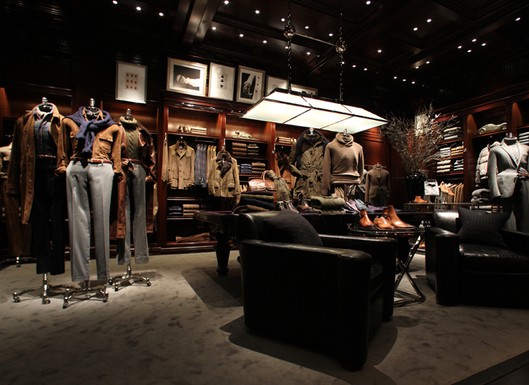
Last week in New York, I stopped by to check out the newly restored Rhinelander, which just reopened as the Ralph Lauren menswear store on Madison and 72nd. Even though it's still hidden behind scaffolding and construction scrim, the store opened for business at the start of Fashion Week. The newly constructed women's & home flagship is set to open across the street in a few weeks.
The space recalls a posh men's club... all polished mahogany, deep leather seating and richly colored hues. It goes without saying that the store is beautifully designed and the service was excellent. However, the RL merchandising team could use a lesson in restraint – in this case, less would be more. As I navigated Purple Label, I nearly knocked over a bespoke mannequin and his friend. I also had trouble finding the timepieces, which I was astounded to learn flank the front door – in plain view, but overshadowed by other gorgeousness. The sky-lit fourth floor RLX boutique was a much needed respite from the navigating dark rooms alongside Russian oligarchs.
Tuesday, August 24, 2010
Nordstrom does it again...
Nordstrom is legendary for great service…. this is the retailer who will take back almost everything and standardized "the walk around" to hand off purchases at the cash wrap. It's no surprise then that Nordstrom's new website, launched last Saturday, is brimming with thoughtful details that put the customer first. Users can now search through products with ever more detailed screening options in every category. Following the mantra that "content is king" the site is building out a section rich with articles and video that feature archetypal customers and their favorite products.
What may be most important change on the site is one you can't see… the inventory policy. While it may sound boring, it's a minor revolution in the retail world that Nordstrom has been linking their stores' inventory with the website. Most web-storefronts treat inventory as wholly separate from stores… hence, a shortage on the website might lead a customer to shop a competitor even though the desired product is on the shelf at one of the stores. It's incredibly hard to implement, but by coordinating inventory between site and store, stores reduce overages, inventory holding costs and markdowns – all the while delighting customers.
As the New York Times reported this morning, the results for Nordstrom's bottom line have been powerful…. Inventory turns are at five-year highs and the company continues to deliver strong profits in a challenging retail environment.
Saturday, August 7, 2010
Mary J. Teaches Marketers a Lesson
Back in May, I wrote about the lame launch of Hermès new fragrance, Voyages d'Hermès. Their abstract, expensive and artsy campaign for a difficult to understand product category did not yield much of an online audience. Getting customers excited about fragrance before product trial is really difficult. So how do you successfully launch a fragrance if web 2.0 marketing strategy aren't effective?
Last weekend, singer Mary J. Blige offered the beauty business a powerful marketing lesson… showing that a potent combination of celebrity, insomnia and a good story goes a long way. Blige launched her scent, "My Life," on the Home Shopping Network (HSN) at midnight on Saturday and proceeded to sell 72,000 bottles in 24 hours, a HSN record. At one point in the day, HSN's servers crashed due to sales volume. Blige's personal narrative of triumph through struggle struck a chord with home shoppers, who called in and shared their own stories before buying the fragrance. Strong narrative is a powerful tool often overlooked in launching new products.
The success of the launch seems to have caught everyone off guard – HSN, industry watchers and even Ms. Blige were overwhelmed by the response. My guess is you'll start seeing Coty running this playbook before the end of this year.
Friday, August 6, 2010
Rise of the Precision Consumer
Two weeks ago, American Express Publishing and marketing consultants at the Harrison Group released the 2010 Survey of Affluence and Wealth in America. The report details changes in the spending habits of wealthy consumers since the beginning of the Great Recession. This latest survey is an excellent indicator of long-term effects of the contraction, since consumers have emerged from their foxholes and are spending again.
One important trend documented is the emergence of wealthy "Precision Consumers." Whereas four-five years ago, these folks loosened their wallets in every category – from apparel to electronics to autos, spending liberally on everything. The Precision Consumer is still interested in luxury products but is better researched and more careful to purchase. They spend liberally in select categories where they feel luxury delivers value and fulfills explicit needs and wants.
This week, a MasterCard Advisors Spending Pulse report showed further evidence of the rise of the Precision Consumer. Spending in the electronics category is growing while apparel spending growth is stagnant. Of course, if you saw the lines outside of Apple stores last month, you didn't need to read a bunch of spending surveys to come to the same conclusion.
Friday, July 16, 2010
Are the Rich Like Us?
As retailers fight to get customers back into stores, prognosticators have hoped the high-end of the market would be the first resume spending. Even though luxury's core wealthy customers have not been as hard hit as aspirationals, there is more evidence that the return to old spending habits is a long way off. The highest end of the market continues to cut back spending in all categories. Maybe the rich really are like the rest of us.
Why is this? Well, wealth (like everything) is relative. Even though it's hard to muster sympathy, in high end real estate markets, the lower end is suffering. Foreclosures and short-sale blues are hitting these consumers just as in middle class markets – one in seven mortgages over $1 Million is seriously delinquent. Last week, the New York Times wrote about the spike in payment delinquencies and short-sales in Los Altos, CA, where the median home price is $1.5 million. Note to Los Altos: Palo Alto is snickering at you.
Luxury retailers are adapting to more careful customer behavior. More customers are making multiple visits to stores before deciding on a purchase. These consumers are not only planning purchases more prudently but waiting for possible discounts and prolonging the thrill of the purchase. Neiman Marcus is one retailer retraining associates to work with customers within the longer sales cycle.
I spoke with one customer who related her story of shopping at Ralph Lauren in Atlanta. She fell in love with an evening gown at the store, but wasn't ready to bite at the $6,000 price point. As soon as the dress was marked down to $2,000, the sales associate called her personally and she was ready to buy. Just like us? Relatively.
Monday, July 12, 2010
Retailers inspire customers to spend more and return less
Summer is in high gear and innovative retailers are exploring ways to make customers feel better about spending, maintain loyalty to their brands and reduce merchandise returns. Here's a rundown of some newer initiatives…
- Several retailers are experimenting with stricter return policies. J Crew's summer sale is now the "Final Sale"… all sales are final. Prior to the recession, upscale retailers almost always accepted exchanges and returns – even on clearance merchandise. However, as inventories are more closely monitored by Wall Street, the final sale is becoming a more common move.
- Store loyalty programs are offering more attractive benefits to bring in new customers. Just as Back to School is rolling out, Target is offering Redcard holders a 5% discount on everyday purchases – this is on top of the 10% one-day signup discount. Expect to see several more store charge cards offer similar programs during Holiday.
- Sam's Club, Walmart's warehouse store for small business, is running a novel experiment to stimulate spending. The store is offering club members affordable loans in conjunction with the Small Business Association to stimulate enterprise growth. While the company will be lucky to break even on the loans themselves, it is betting that when club members' businesses grow, so will Sam's Club.
Labels:
Inventory management,
J Crew,
Loyalty Programs,
Sam's Club,
Target,
Wal-Mart
Monday, June 7, 2010
Luxury Marketing 101
For a luxury brand to develop its customer base, it must build awareness. But sometimes, high consumer awareness undermines goals - a brand can upset or drive away core or likely customers.
I find this 2X2 helpful for understanding why a brand appeals to certain consumers, which is a good place to start devising marketing and partnership strategy. I divided awareness on two axes: the vertical axis represents mass-consumer awareness and the horizontal is awareness among likely and current luxury customers.
In the upper right-hand quadrant, you’ll find brands that are instantly recognizable. These brands make big statements. It’s no wonder that the brands playing in this space appeal especially to consumers who are be a wee-bit ostentatious... They like driving a Mercedes that everyone knows is luxury.
Quadrant 2 contains luxury brands for whom mass awareness is unappealing – but its still very important that luxury consumers understand and identify the brand. Bottega Veneta derives much of its brand strength by creating the perception of discreteness. A signature weave, never a logo, makes a subtle but clear statement to peers.
Some brands thrive in relative obscurity... lower left-hand quadrant contains brands that are regional or for luxury connoisseurs. These customers derive a great deal of satisfaction from being in on a brand-secret and might be upset if it becomes too well-known… even by peers. John Lobb would have a hard time making customers covet $4,000 shoes without this sort of proposition.
Why would a luxury brand ever want to have low awareness by likely customers and high awareness among a mass audience? Even if it did make sense, I’m not sure it’s possible.
Subscribe to:
Posts (Atom)