Fighting my way through Black Friday crowds at big box stores for "door-buster" promotions holds little appeal; yet I certainly don't go out of my way to abstain from shopping over Thanksgiving weekend. American Express is promoting the first-ever Small Business Saturday aimed at supporting one of their core market segments: small retailers. If you have time tomorrow, take an hour to stroll down downtown and patronize a local business. If the weather outside is frightful, here are some of my favorite places to find small businesses online:
Etsy: The ultimate affordable art gallery… thousands of artists and craftsmen sell their wares. The selection can be overwhelming, but it's great fun to explore.
Taigan: An online mall filled with some of the finest boutiques from around the country. Each store has a beautifully edited selection of stylish wares.
Desquval: Always ahead of the fashion curve? Here you find quality and value while supporting the ateliers of emerging designers.
A few months ago, I discussed the surgical approach internet shoppers take toward making purchases. In contrast, shoppers in the stores channels have the opportunity to linger and discover delightful products they never intended on buying. This is the provenance of product merchandisers who design store windows, build displays and arrange shelves strategically to create a sense of discovery for customers. Until recently, e-commerce sites have used automated suggestions by aggregating data (Amazon's "customers who bought item X also bought Y") or using the brilliant insight that if you're buying sheets, you might also want pillows. The suggestions are usually so predictable that they don't allow space for true discovery of product, which can lead to unplanned (and more profitable) sales.
A new crop of sites is using a potent combination of evolving search technologies and "curated" (merchandised) content to divert the attention of the precision consumer less predictable ways. Nordstrom.com includes a regularly updated sort of e-zine that encourages customers to explore and be inspired by a number different brands and styles. The current issue highlights a stylish couple's unconventional wedding, a city profile of Chicago and a Vogue-worthy event-attire layout. "The Conversation" offers interesting articles and is beautifully photographed – more importantly, it gives customers the chance to spot items (like a pretty Leifsdotter skirt) they wouldn't otherwise through a standard category/brand search.
Perhaps the most exciting new merchant enlivening online shopping is Google's Boutiques.com. The company uses Like.com's (acquired by Google) advanced search technology, which recognizes style genres, shapes, patterns, hemlines, etc. Boutiques.com invited a number of celebrities, stylists, designers and influential bloggers to pull women's merchandise from sellers to create a signature look that is posted in a personalized boutique; customers shopping from the boutique are directed to sellers to complete the purchase. Google tapped into a cultural obsession (and well established product marketing strategy) by hiring celebrities as their merchandisers... each one has a fan base that aligns with a target and position. Site users can also create a personalized boutique by establishing preferences for style genre and product attributes.
Besides being smart and original, both sites are slickly produced and genuinely fun. Best of all, surgical shoppers are encouraged to take time to explore and discover new merchandise.
Even though it seems like Labor Day was just last week, the holiday shopping onslaught is upon us. In the wee hours of Friday morning, legions of American shoppers will pour into retailers for "door-buster" promotions.
Much has been made of in recent years of Cyber Monday (horrible name), which is the day Americans return to work and go shopping online. Offers of free shipping and deals consumers may have missed on Friday are made available online. These promotions are being extended as early as the Wednesday before Thanksgiving. This is good news not only for employers who get precious little output on Monday, but also takes significant pressure off retailers' stores channel. Early online promotions are one way to head off stampede concerns at your local Walmart.
So here's a holiday wish for all of you who are braving the stores this year… I hope you find civility and good service in addition to the items you're looking for. When you don't, I wish you the patience and fortitude to blithely smile and keep your sense of humor intact.
Memories of my first semester of b-school came flooding back as I watched Inside Job. The films highlights the enormous negative impact sleazy traders, incomprehensible financial instruments, lazy regulators and misguided mathematical geniuses have had on the world. As I entered school in Fall 2008, no one wanted to work for a hedge fund anymore.
Demand for sterling cuff links and Paul Stuart suits melted along with the global economy. However, an enduring style trend quickly emerged. From Paris to Hong Kong, fine boutiques are stocking heritage brands like Gitman, Woolrich and Red Wing. People are choosing earthy plaids and chambrays over fine English Oxfords. Denim is worn with cuffs rolled up and khakis are comfortably wrinkled instead of neatly pressed. Especially this fall, major American cities look as though they're mostly populated by early 20th century farm-workers and machinists. Much to my chagrin, facial hair (untamed beards and bushy moustaches) has made a big comeback among the hipster crowd.
It's no wonder consumers are dressing the part of laborers, they are looking to the heritage brands of their childhood in order to associate themselves with people who actually produce things. While it has a decidedly masculine tone, the trend is not limited to menswear. Perhaps the most baffling incarnation of this trend was Ralph Lauren's Spring 2010 Collection, which put a luxe spin on the Grapes of Wrath (one signature piece was a silver lamé overall gown.) The connection to labor doesn't stop with clothes. Moss, the Soho über-chic shelter gallery, just wrapped up an exhibition of aggressively industrial-yet-handmade pieces. Unsurprisingly, the New York Times noted recently that mainstream media has adopted a more masculine version of the ideal male.
I'm sure we'll find a reason to dress to-the-nines again soon, but in the meantime I'm enjoying dressing the part of a lumberjack (sans facial hair) several days a week.
Today I'm baking my grandmother's famous (to me) cookie recipe. Grammy made sure not one birthday (neither mine, my siblings nor cousins) passed without us receiving a crisp $5 bill and a tin full of oatmeal cookies. She was not short on grandkids, so this was not an insignificant sacrifice of time nor money. The taste of these particular cookies evokes my happy childhood and my tough-yet-tender grandmother, baking many dozens of cookies in her tiny trailer kitchen.
Consumer behavior experts tell us the most effective messages to potential customers trigger deep associations with the past by tapping into our long-term memory. Think of the moment Anton Ego tastes Remy's creation in Ratatouille… he is catapulted back a happy memory of childhood in the French countryside. Creating these types of deep associations is incredibly difficult (and expensive) for product marketers. Reams of consumer research, thousands of hours of work of talented marketers and brilliantly creative ideas are a start, but don't guarantee a consumer will form the association a company aims to create. Oddly, this is what the cookies reminded me of.
For those of you who want to do some baking, here's the recipe (so easy, an MBA can do it.) Now, not so secret.
Oatmeal Crispies (makes 5 dozen)
1 cube Nucoa (margarine) and ½ cup Crisco (or 1 cup [2 sticks] unsalted butter at room temperature)
1 ¼ cups dark brown sugar
1 cup white sugar
2 eggs
1 tsp vanilla
1 ½ cups flour mixed with 1 tsp baking soda
3 cups quick cooking oats (whole oats are fine)
A generous helping of love (Grammy's words, not mine.)
Directions:
Preheat oven to 350. Cream brown sugar with Nucoa and Crisco (butter), add white sugar and stir until creamy again. Add vanilla and eggs, mix well. Add flour and soda and mix thoroughly. Add oats and Love and stir until there are no dry oats. [at this point, I drop them in teaspoon size balls onto a baking sheet and bake at 350 for 9-12 minutes, until the edge of the cookies are brown, but not burned.] Form in rolls, wrap in waxed paper and chill. Cut into ¼" slices and bake on ungreased cookie sheet 10 to 12 minutes at 350. Makes approximately 5 dozen. Enjoy.
Hermès just opened the first outpost of Shang-Xia, a new luxury lifestyle brand based in PRC for PRC consumers. The brand reflects Hermès' legacy of artfulness and fine craftsmanship. Products like cashmere sweaters and fine porcelain showcase Chinese craft traditions with a contemporary minimalist twist. The small store opened in Shanghai at the Hong Kong Plaza Mall, additional stores are planned for Paris and Beijing in due course.
The establishment of Shang-Xia is evidence Hermès has found its footing in China and has the confidence to experiment. It may also confirm that the PRC consumer is growing more sophisticated. David Tang's Shanghai Tang has an early lead as the original homegrown luxury brand. PRC Consumers are experimenting beyond European and American brands – and are prepared to embrace a distinctly Chinese take on luxury lifestyle.
Shang Xia is the second Asian brand to be launched by a western company. Last month Levi Strauss & Co established Denizen, a denim brand aimed at the PRC mass market.
Last week in New York, I stopped by to check out the newly restored Rhinelander, which just reopened as the Ralph Lauren menswear store on Madison and 72nd. Even though it's still hidden behind scaffolding and construction scrim, the store opened for business at the start of Fashion Week. The newly constructed women's & home flagship is set to open across the street in a few weeks.
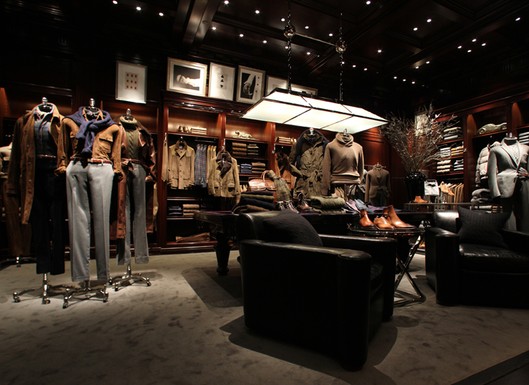
The space recalls a posh men's club... all polished mahogany, deep leather seating and richly colored hues. It goes without saying that the store is beautifully designed and the service was excellent. However, the RL merchandising team could use a lesson in restraint – in this case, less would be more. As I navigated Purple Label, I nearly knocked over a bespoke mannequin and his friend. I also had trouble finding the timepieces, which I was astounded to learn flank the front door – in plain view, but overshadowed by other gorgeousness. The sky-lit fourth floor RLX boutique was a much needed respite from the navigating dark rooms alongside Russian oligarchs.
Nordstrom is legendary for great service…. this is the retailer who will take back almost everything and standardized "the walk around" to hand off purchases at the cash wrap. It's no surprise then that Nordstrom's new website, launched last Saturday, is brimming with thoughtful details that put the customer first. Users can now search through products with ever more detailed screening options in every category. Following the mantra that "content is king" the site is building out a section rich with articles and video that feature archetypal customers and their favorite products.
What may be most important change on the site is one you can't see… the inventory policy. While it may sound boring, it's a minor revolution in the retail world that Nordstrom has been linking their stores' inventory with the website. Most web-storefronts treat inventory as wholly separate from stores… hence, a shortage on the website might lead a customer to shop a competitor even though the desired product is on the shelf at one of the stores. It's incredibly hard to implement, but by coordinating inventory between site and store, stores reduce overages, inventory holding costs and markdowns – all the while delighting customers.
As the New York Times reported this morning, the results for Nordstrom's bottom line have been powerful…. Inventory turns are at five-year highs and the company continues to deliver strong profits in a challenging retail environment.
Back in May, I wrote about the lame launch of Hermès new fragrance, Voyages d'Hermès. Their abstract, expensive and artsy campaign for a difficult to understand product category did not yield much of an online audience. Getting customers excited about fragrance before product trial is really difficult. So how do you successfully launch a fragrance if web 2.0 marketing strategy aren't effective?
Last weekend, singer Mary J. Blige offered the beauty business a powerful marketing lesson… showing that a potent combination of celebrity, insomnia and a good story goes a long way. Blige launched her scent, "My Life," on the Home Shopping Network (HSN) at midnight on Saturday and proceeded to sell 72,000 bottles in 24 hours, a HSN record. At one point in the day, HSN's servers crashed due to sales volume. Blige's personal narrative of triumph through struggle struck a chord with home shoppers, who called in and shared their own stories before buying the fragrance. Strong narrative is a powerful tool often overlooked in launching new products.
The success of the launch seems to have caught everyone off guard – HSN, industry watchers and even Ms. Blige were overwhelmed by the response. My guess is you'll start seeing Coty running this playbook before the end of this year.
Two weeks ago, American Express Publishing and marketing consultants at the Harrison Group released the 2010 Survey of Affluence and Wealth in America. The report details changes in the spending habits of wealthy consumers since the beginning of the Great Recession. This latest survey is an excellent indicator of long-term effects of the contraction, since consumers have emerged from their foxholes and are spending again.
One important trend documented is the emergence of wealthy "Precision Consumers." Whereas four-five years ago, these folks loosened their wallets in every category – from apparel to electronics to autos, spending liberally on everything. The Precision Consumer is still interested in luxury products but is better researched and more careful to purchase. They spend liberally in select categories where they feel luxury delivers value and fulfills explicit needs and wants.
This week, a MasterCard Advisors Spending Pulse report showed further evidence of the rise of the Precision Consumer. Spending in the electronics category is growing while apparel spending growth is stagnant. Of course, if you saw the lines outside of Apple stores last month, you didn't need to read a bunch of spending surveys to come to the same conclusion.
My perfect world? One where experiences and products always exceed expectations and are (in a word) delightful. Here I share my thoughts about my never-ending quest to discover and create memorable customer experiences.